Bibal. 23 fashion brands. 60-minute delivery. One Shopify platform built from scratch to run both.
Client
Bibal
Year
2024–Present
Scope of Work
Bibal delivers trendy clothing in under 60 minutes in Bangalore. Not same-day. Under an hour. That window is the product, and it put specific demands on every layer of the platform.
The brief
The brief was not to build a store. It was to build a platform. 23 independent fashion brands across 73 collections from a single Shopify instance, each vendor with their own inventory, their own payout structure, and their own product attribution on every page. Shopify does not do multi-vendor payout tracking out of the box. And the entire thing had to be built mobile-first, designed from the start to become a native app. The Shella theme was the starting point. Nothing from it remained.
The platform was rebuilt from scratch. Custom bottom navigation, a pin code delivery eligibility check at store entry, editorial trending sections, a Liquid-driven trust system on every product page, and Shopify Flow automation connecting order data to vendor payout tracking in Google Sheets. Every design decision anticipated the app conversion: navigation patterns, touch targets, scroll performance, information hierarchy at 390px.
It became one. Android and iOS both launched on the same custom mobile-first foundation. Bibal is an active retainer. The platform is live.
The Shella theme shipped with a generic header. This one opens with a promise.
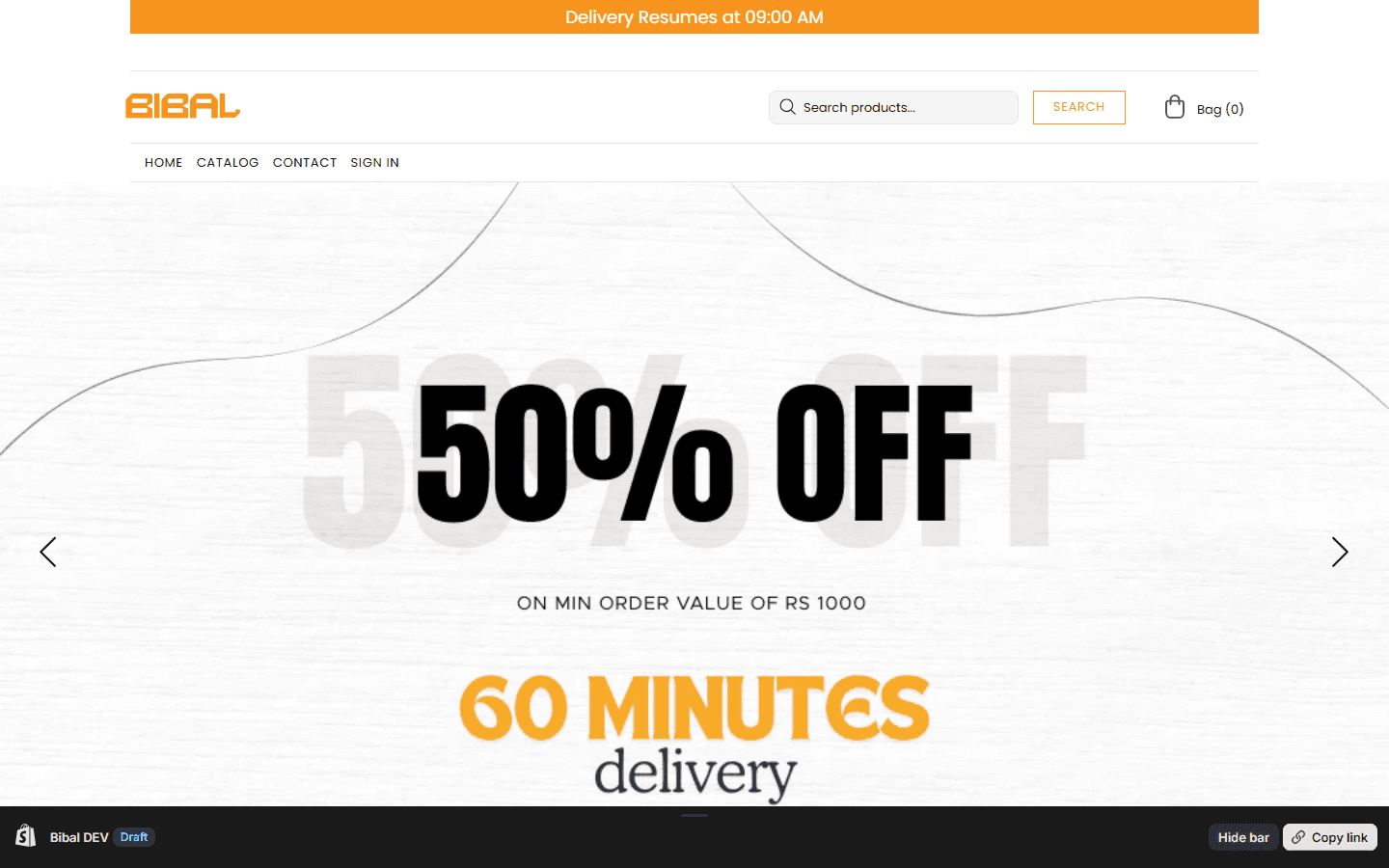
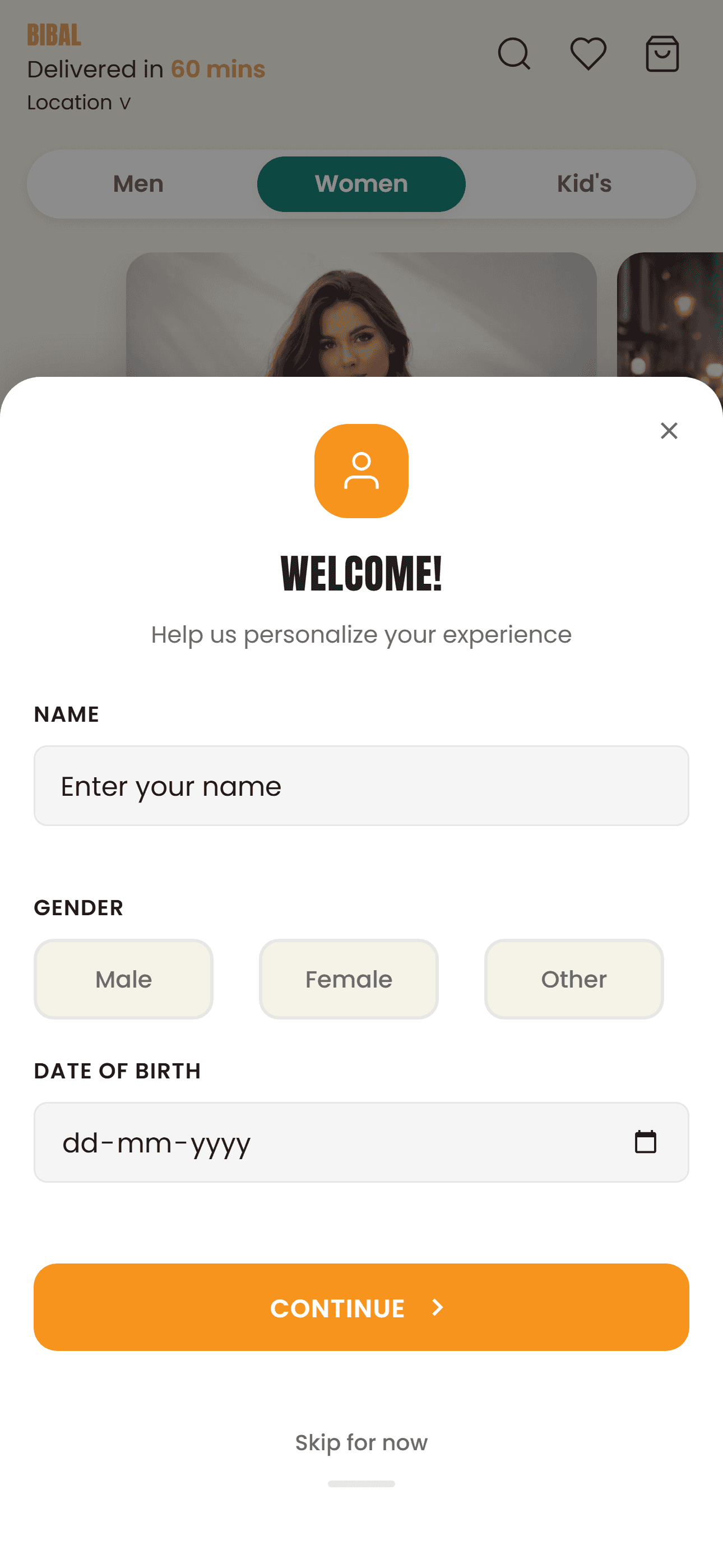
Shella's default header is a logo, a navigation bar, and a search icon. Nothing tells a new visitor whether their postcode is serviceable. Bibal's header opens with "Delivered in 60 mins" in orange, visible on every page, before any product is shown. The pin code popup fires on first visit: a single input, a confirm button, an immediate yes or no. The customer knows whether Bibal delivers to their location before they look at a single product. That decision moved from checkout, where abandonment is catastrophic, to the front door. It is not a modal in a marketing sense. It is a service check that respects the customer's time.
Two ways to browse. One catalog behind both.
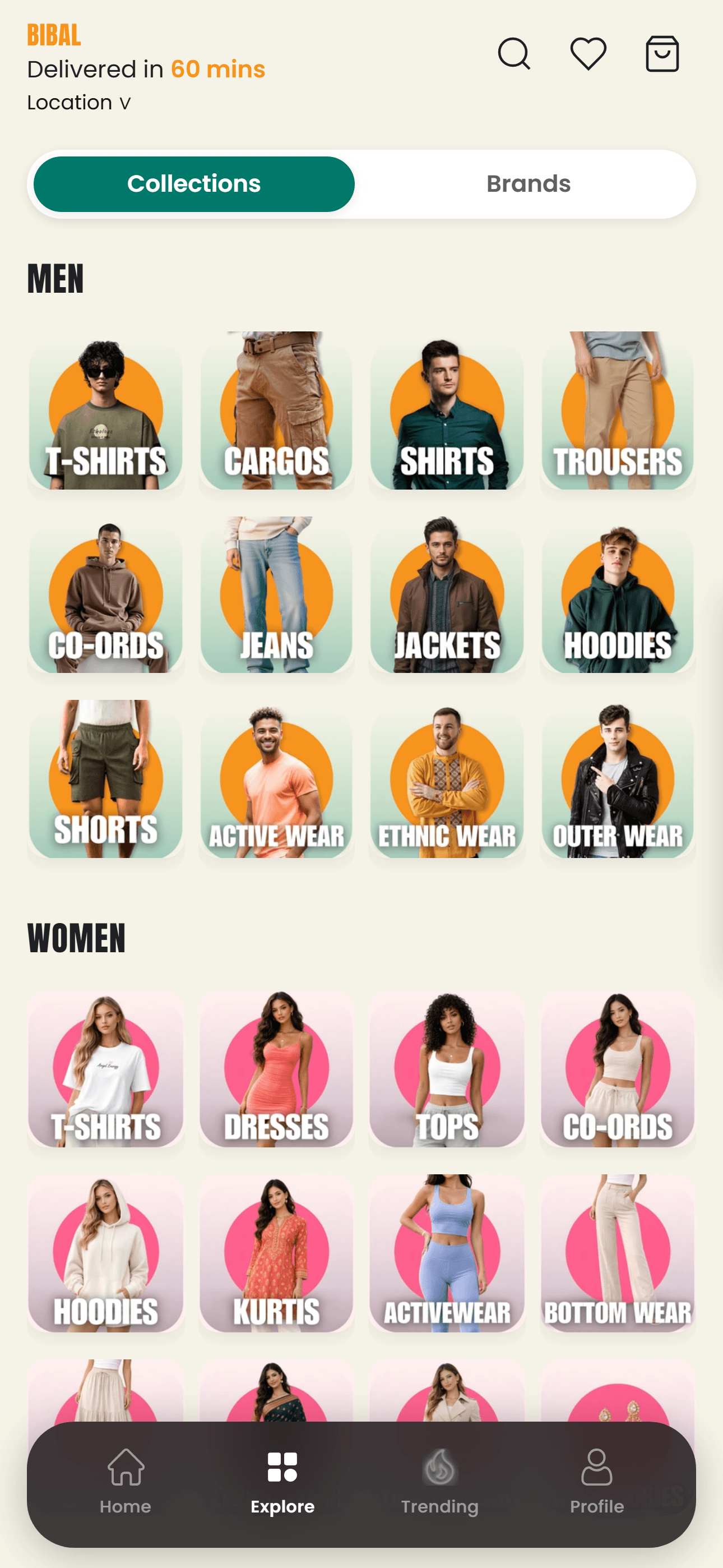
Shella's navigation is a hamburger menu with nested category links. A customer arriving from a Meta ad has no patience for that. The Explore page gives customers a choice the moment they land. The Collections tab organises everything by type: T-Shirts, Cargos, Shirts, Co-ords, Jeans, Jackets, Hoodies, Shorts, Active Wear, Ethnic Wear, Outer Wear across Men, Women and Kids. The Brands tab shows every vendor in a 4-column logo grid with their actual brand identity. ECHOLOPE, BALLUCCI, KAMEROON, FORGE, FOOLHARDY, URBAN DOMINANCE, and 17 more. The customer who knows their label goes straight to the brand page. The one still exploring goes by category. Both paths lead to the same product pages and the same checkout. The bottom navigation (Home, Explore, Trending, Profile) was built from day one to match the structure the storefront would carry into its Android and iOS apps.
The Trending page is an editorial, not a filtered collection.
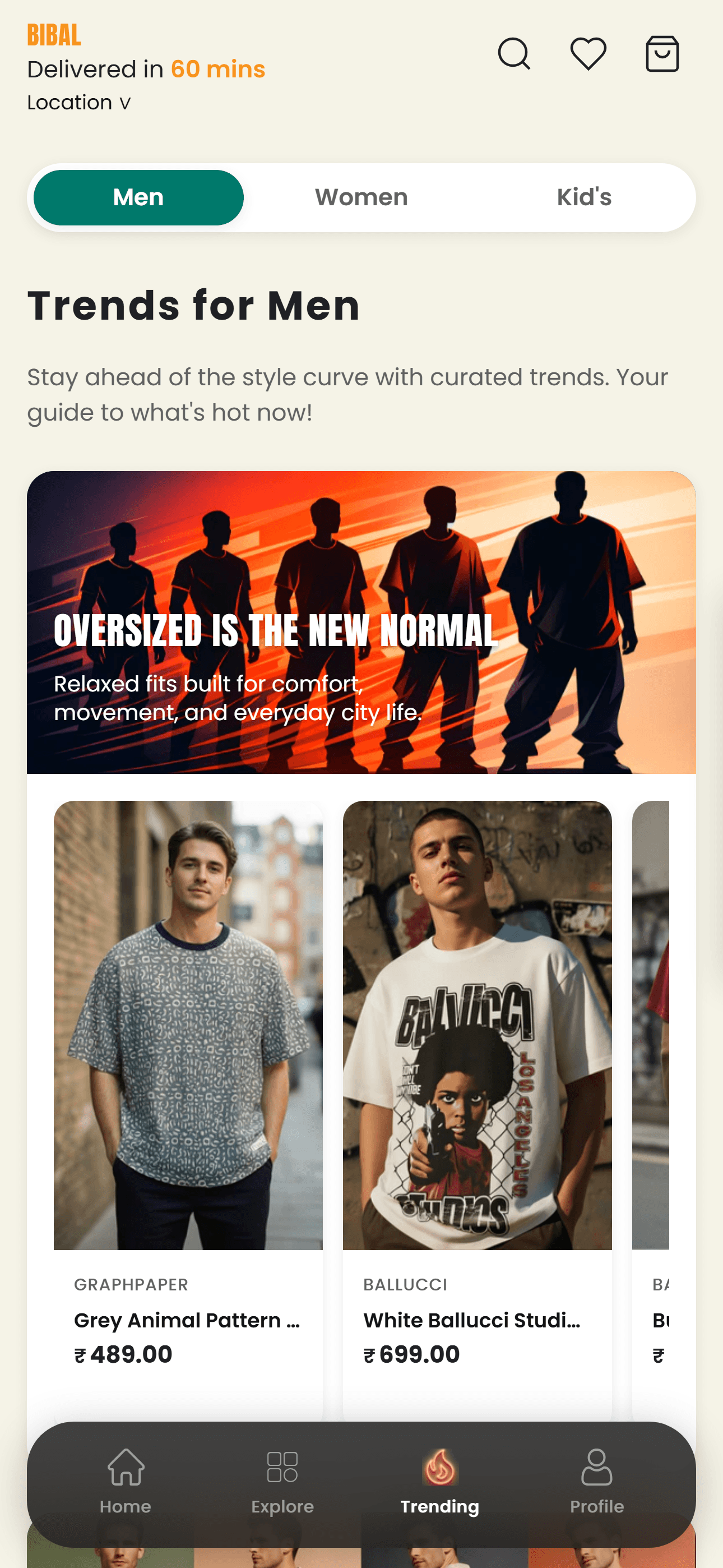
A standard Shopify collection page gives you a grid, a sort dropdown, and filters. Nothing tells the customer what is in style this week. The Men, Women and Kids tab switcher sits at the top of Trending. Each section opens with a full-bleed editorial banner: bold copy layered over product photography. OVERSIZED IS THE NEW NORMAL. MATCHED. MINIMAL. MOVING FAST. The products sit immediately below with vendor attribution on every card. GRAPHPAPER at Rs 489. BALLUCCI at Rs 699. A customer on the Trending page should feel like they are being told what is hot right now, not browsing a sorted list. The editorial banners are built through a custom Shopify section schema so the Bibal team can update the headline copy each week without touching Liquid.
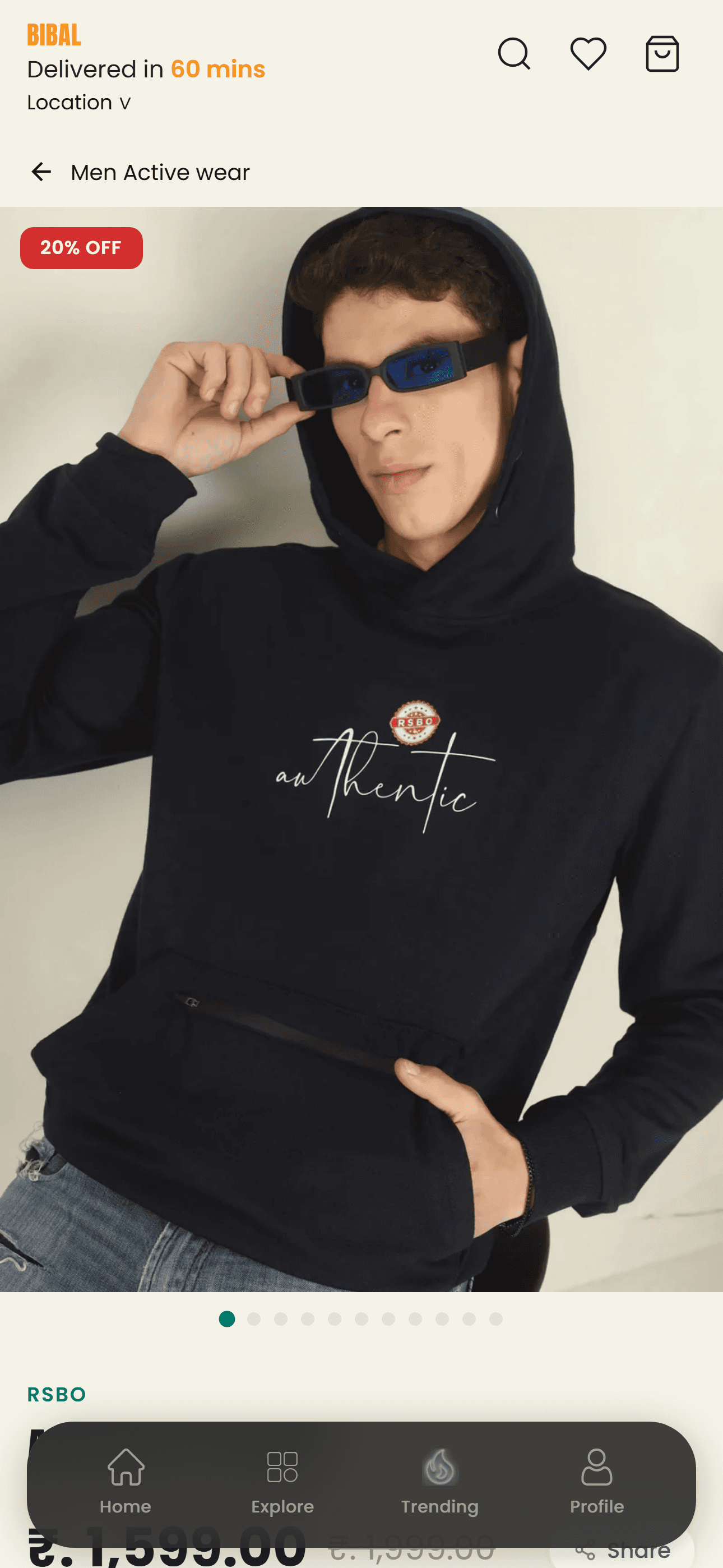
A generic PDP with no delivery commitment. This one has three answers built in.
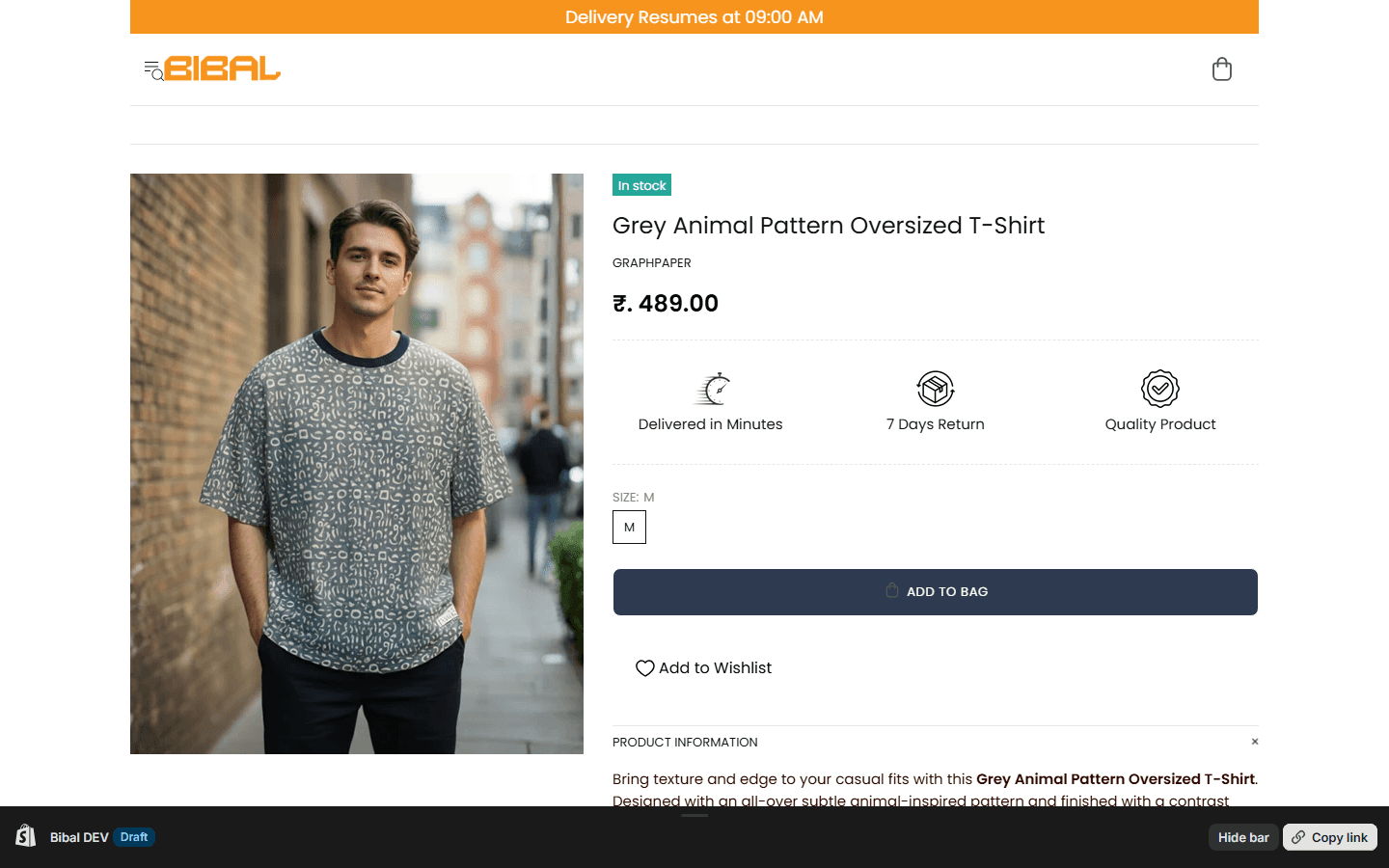
Shella's product page shows a title, a price, and a buy button. Vendor attribution sits in the metafields, invisible. There is no delivery promise on the page. Bibal's product page leads with the vendor name in teal above the title. NORZY PARIS. Price at Rs 549, down from Rs 1,599. 66% off in a green badge anchored below. Size selector, Share button, a wishlist heart. A Try on me button for virtual fit. Then three trust cards below the buy button: 60 Min Delivery with a truck icon, 7 Day Returns, Quality Assured. Every one of those cards is rendered through a custom Liquid section that applies the same trust layer to every product regardless of which vendor it belongs to. The whole page was designed knowing it would live on a phone screen.
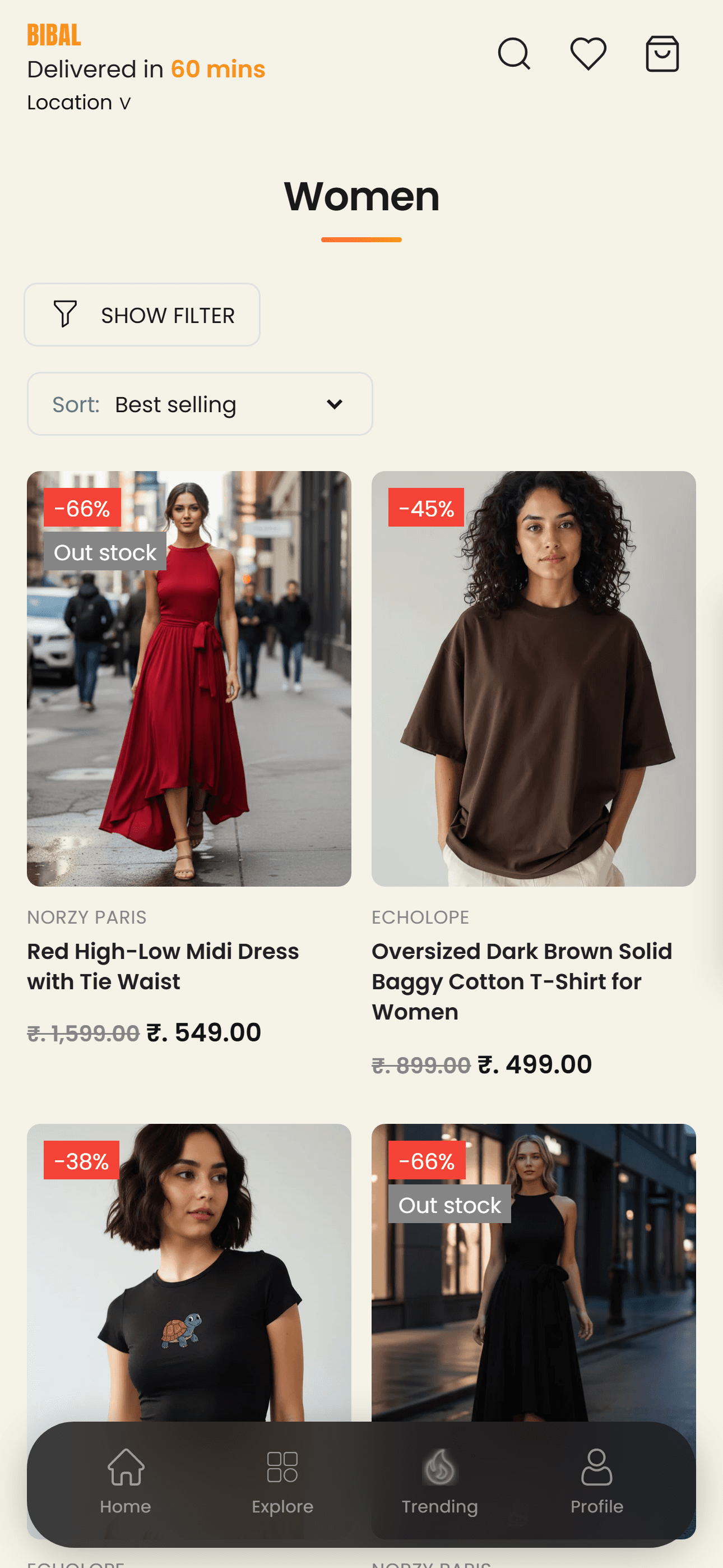
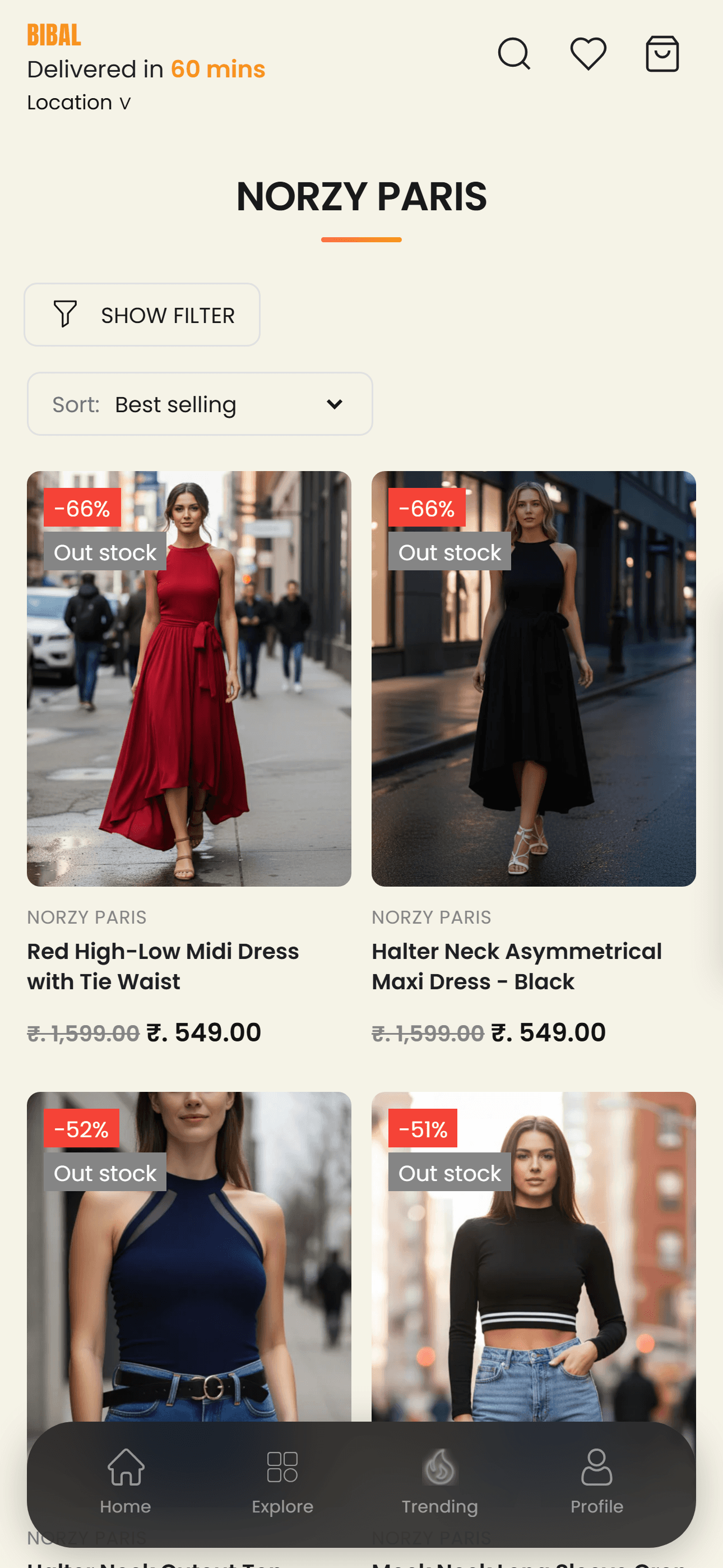
73 collections and 23 brand pages. One product card component across all of them.
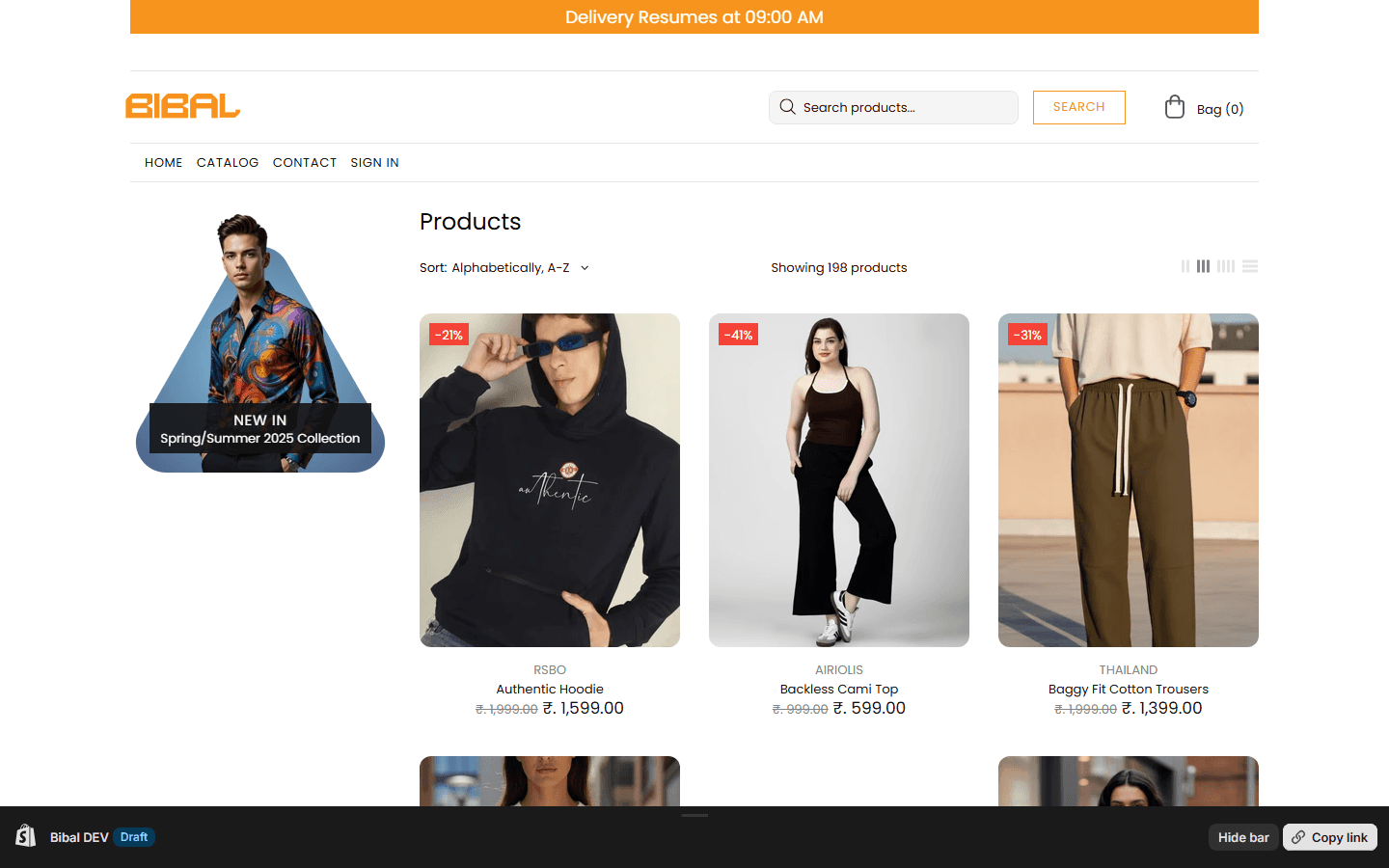
Shella renders a standard collection grid with no vendor attribution. A customer browsing Women cannot tell which brand made a product until they open the product page. The Women collection view and the NORZY PARIS brand page on Bibal run on the same card system. Vendor name above the product title. Strikethrough original price with the sale price prominent. Percentage badge anchored top left. Out of stock flagged with an overlay tag rather than removing the product from the grid entirely. Filter and sort controls sit above the grid on every view. The card component was written once in Liquid and renders consistently whether the customer arrived through a category or a brand. With 73 collections and 23 vendor pages live in the store, a single card definition was not a choice. It was a requirement.
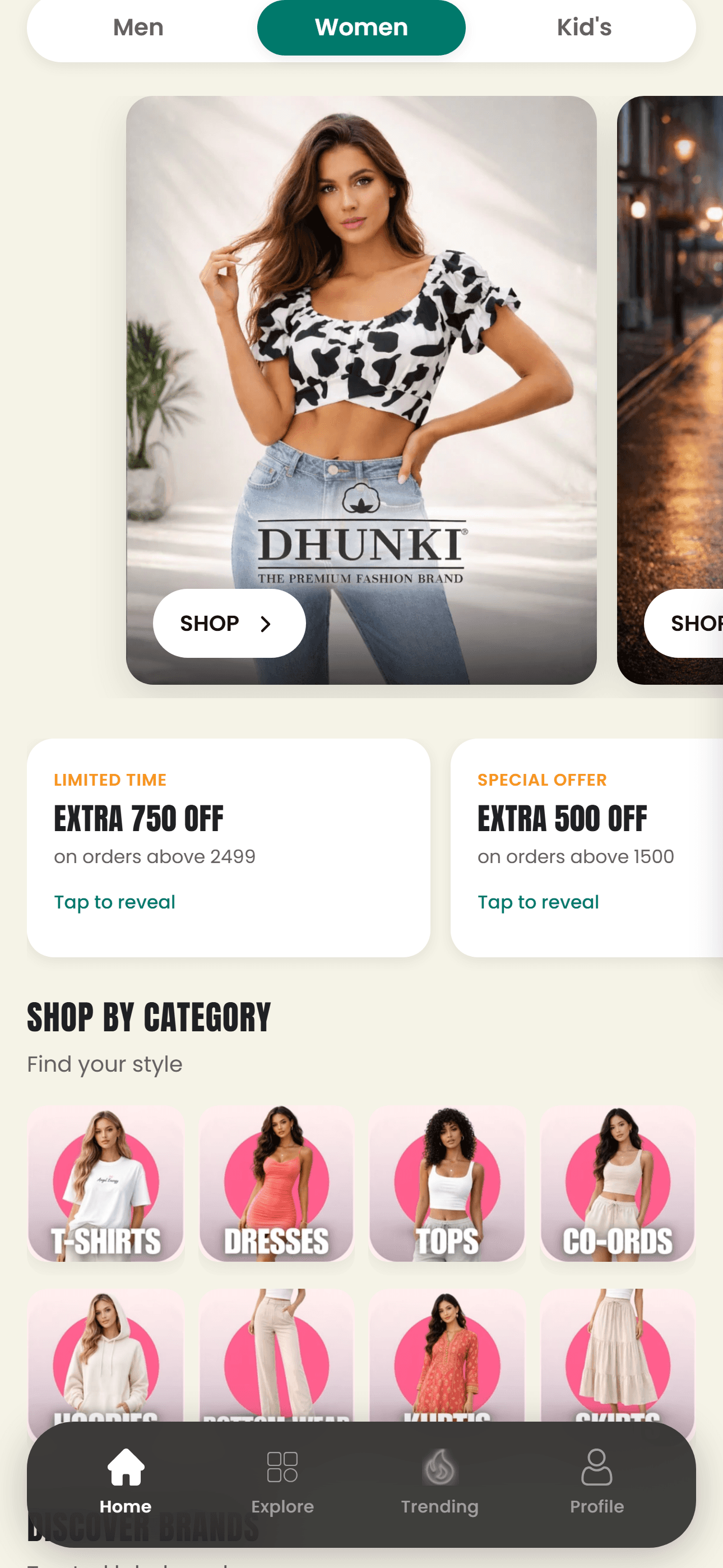
Built to become an app. Then it did.
The architecture was designed for app conversion from the first line of Liquid. Bottom tab navigation (Home, Explore, Trending, Profile) mirrors native iOS and Android patterns. Gesture targets meet mobile touch guidelines. Information hierarchy was validated at 390px before it was validated at 1440px. When the Android and iOS builds were commissioned, no navigation patterns needed changing, no interaction models needed rethinking, no layout logic needed refactoring. The storefront architecture transferred without modification. The Bibal app is live on the Google Play Store and the Apple App Store.
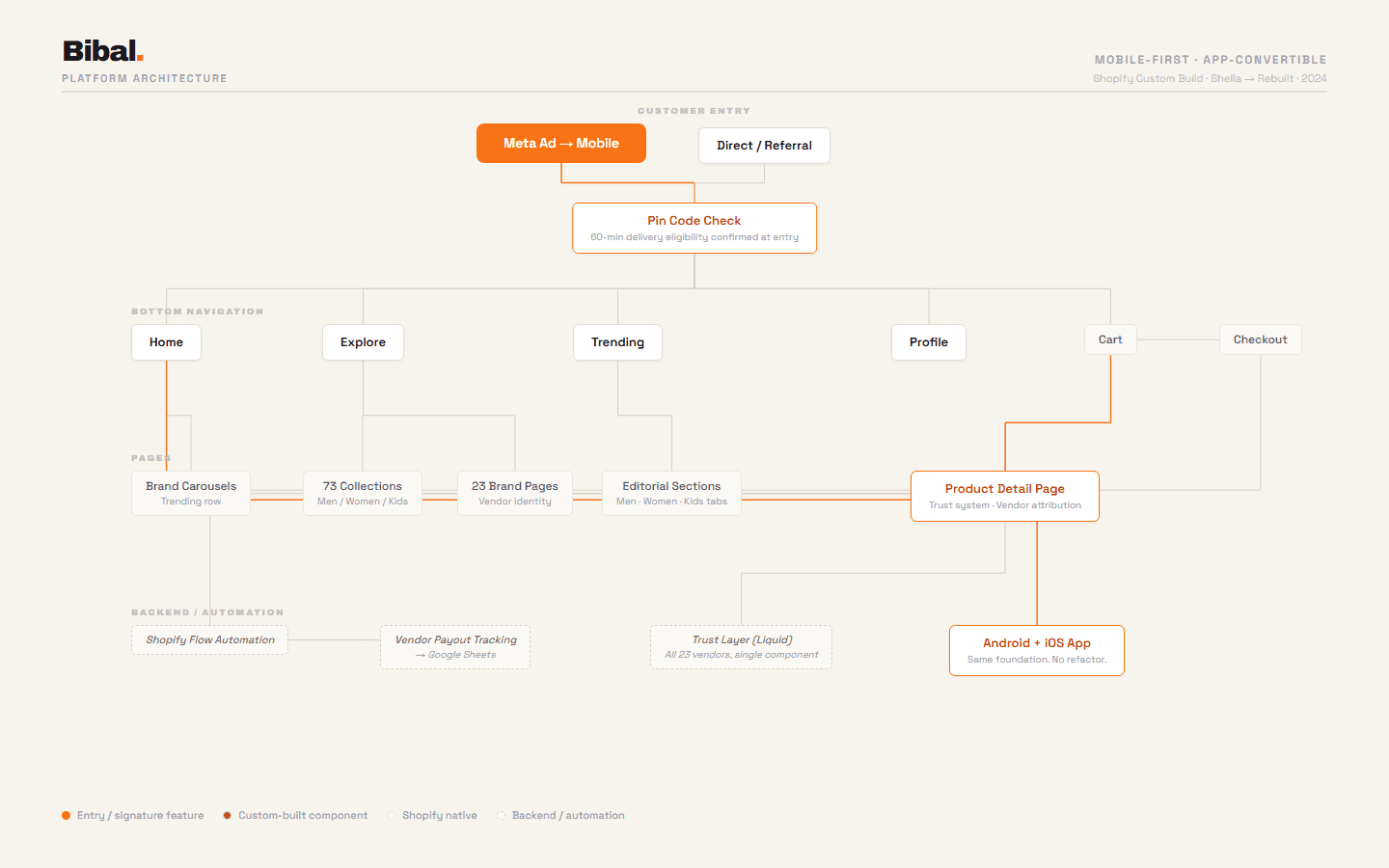
The architecture was designed for app conversion, not adapted for it.
The brief required two things not in Shopify's box: multi-vendor payout logic across 23 independent brands, and a storefront architecture that would transfer cleanly to native apps. Both required decisions made at the planning stage, not retrofitted after launch. The pin code eligibility check was placed at store entry, not checkout. The bottom navigation was defined as a fixed four-tab component from the first wireframe. Every Shopify Flow automation was mapped before the first Liquid file was opened. Shopify was used as infrastructure. The product was built from scratch on top of it.
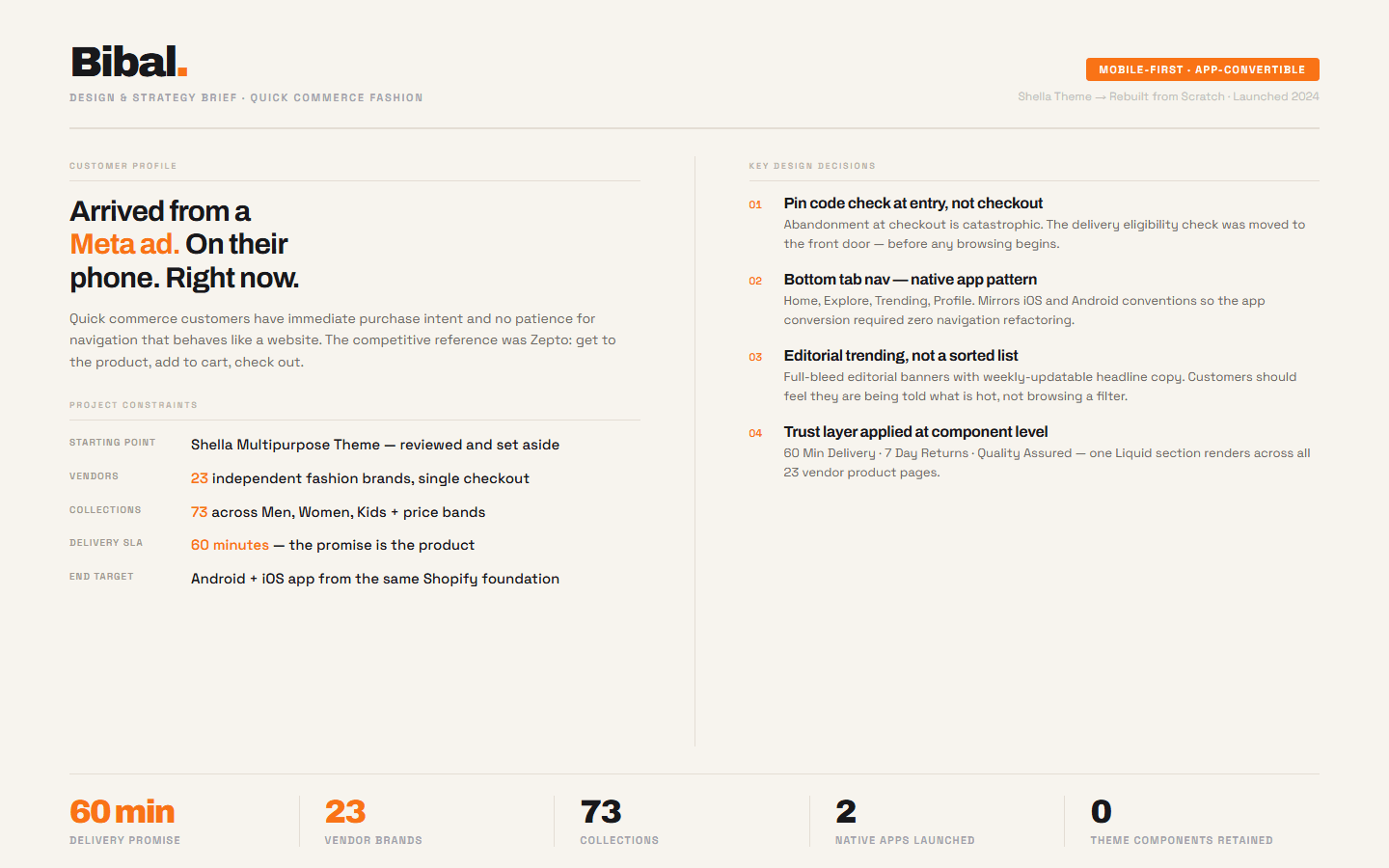
Research before Liquid.
Quick commerce customers in Bangalore arrive from Meta ads on their phones. They have immediate purchase intent and no patience for navigation that behaves like a website. The competitive reference was Zepto: get to the product, add to cart, check out, done. Every design decision was tested against one question: does this slow the customer down. The Shella theme was opened, reviewed, and set aside. Everything on the storefront was rebuilt from the first section. Font choices, card components, the trust layer, the bottom navigation, the editorial banners on the Trending page — none of it came from the theme. The research phase ended with a complete scope definition and a clear app conversion roadmap before any Liquid was written.
Performance.
The storefront runs on custom Liquid with no third-party JavaScript for core interactions. The bottom navigation is CSS position fixed. The pin code popup is vanilla JavaScript. Core Web Vitals from PageSpeed Insights, January 2025: mobile 82, desktop 94.
One thing I would do differently
Build the vendor payout reconciliation into a proper database from day one. Google Sheets works at 23 vendors, but the data model will crack at 50. The Shopify Flow automation is solid. The output destination needs to be a proper ledger, not a spreadsheet.